
Planning permission and noise reports for padel courts
Outdoor padel courts in Ireland normally require full planning permission from the local authority, even when replacing an existing tennis court. Four-metre tempered glass and weld-mesh walls, concrete ring beams and 6 m LED floodlight masts fall outside domestic and club exemptions, and councils routinely request a Noise Impact Assessment and lighting spill contour plan near houses. Professional planning drawings, a Noise Impact Assessment and lighting spill contours typically budget €4,500 to €12,000 ex VAT before council application fees.
Why outdoor padel builds need full Irish council permission, how ball-on-glass noise is modelled and how clubs avoid refusals.
Free, no obligation. One local builder prices it, not five.
- Full PPrequired for outdoor cages & LEDs
- 8–12 wksstandard council decision window
- €80 / 4 wksSection 5 declaration fee & time
- €4,500–€12,000typical drawings, noise & lux reports
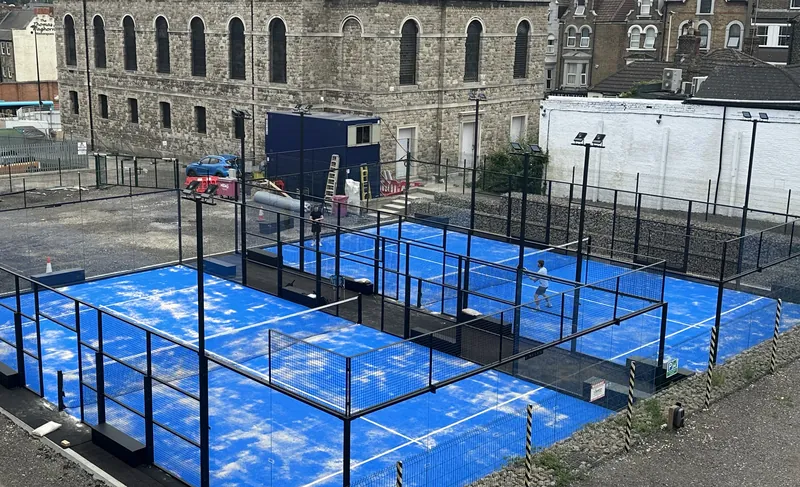
Why outdoor padel courts almost never qualify as exempt in Ireland
Under the Planning and Development Act 2000 and Planning and Development Regulations 2001 (S.I. No. 600 of 2001), some clubs initially hope replacing an existing hard tennis court with padel cages counts as exempted development. In practice, Irish local authorities and An Bord Pleanála rulings on Section 5 declarations (€80 fee, 4-week statutory period) consistently hold that 4 m high tempered glass and weld-mesh enclosures, permanent concrete ring beams and 6 m floodlight columns constitute material development requiring full planning permission.
Submitting a clean, evidence-backed full planning application upfront, complete with acoustic and lighting mitigation, is far quicker than battling enforcement notices or multiple Requests for Further Information (RFIs).
Impulsive ball-on-glass & racket noise
- Why Irish councils flag it
- Sharp repetitive 'pop' travels clearly across quiet suburban estates at night
- Proven mitigation to include upfront
- Acoustic consultant NIA, court orientation, 3–4 m absorptive boundary barrier or canopy
Evening floodlight glare
- Why Irish councils flag it
- 6 m masts near roads, houses or bat foraging hedgerows
- Proven mitigation to include upfront
- 0-degree horizontal asymmetric LEDs, rear cowls, spill contour map & 9:30–10 pm timer
Surface water runoff (SuDS)
- Why Irish councils flag it
- 264 m²+ impermeable concrete alters local storm drainage
- Proven mitigation to include upfront
- Porous macadam/concrete infill, perimeter drains and sized on-site soakaway
Visual mass of 4 m cages or 8 m canopies
- Why Irish councils flag it
- Suburban amenity, coastal views or rural landscapes
- Proven mitigation to include upfront
- Dark green/anthracite steel frames, native hedgerow screening and recessed levels
Price my court
Four quick taps and your ex-VAT Irish build budget appears before we ask for a phone number. One padel builder rings you, not five.
2 courts, panoramic outdoor padel, full ring-beam slab, cage and LEDs: €109,000 to €179,000 ex VAT.
How the budget range is worked out
Ranges show typical Irish ex-VAT contract figures for FIP-spec courts built for Irish wind zones. Turnkey outdoor estimates cover excavation, reinforced concrete ring-beam slab with porous infill, EN ISO 1461 hot-dip galvanised steel cage, 10 mm or 12 mm tempered glass, 12 mm synthetic turf with silica sand infill, and 8 × 200W asymmetric LED floodlights. Covered estimates include a wind-rated steel portal or arched canopy (7 m to 8 m eaves height) and pad foundations. VAT (13.5% or 23% under Revenue rules), council planning fees, acoustic reports, mains power upgrades and rock-breaking are confirmed after a site survey.
Acoustic assessments: managing ball-on-glass noise near houses
Noise is the number-one reason padel applications attract objections from neighbours across Ireland. Unlike tennis, where balls hit strung rackets across an open court, padel balls strike solid carbon or fibreglass faces and rebound sharply off 12 mm glass walls at 60 to 70 dBA at 10 m, accompanied by close-quarters player speech.
- Keep generous separation where land allows. Sites 60 to 100 m+ away from dwellings pass acoustic checks cleanly. Within 30 to 50 m of houses, commission an Irish acoustic consultant before lodging drawings.
- Use glass back walls as directional shields. Solid tempered glass reflects sound back inward better than open side weld-mesh; orient the courts carefully relative to the nearest residential boundary.
- Budget for absorptive acoustic barriers if close to gardens. A 3 to 4 m absorptive timber acoustic fence along a sensitive boundary (€12,000 to €28,000 ex VAT) can cut received decibels sharply.
- Propose realistic evening cut-off hours upfront. Offering an automatic 9:30 pm or 10:00 pm curfew in the application reassures Environmental Health Officers and prevents overly tight conditions.
Related padel construction guides
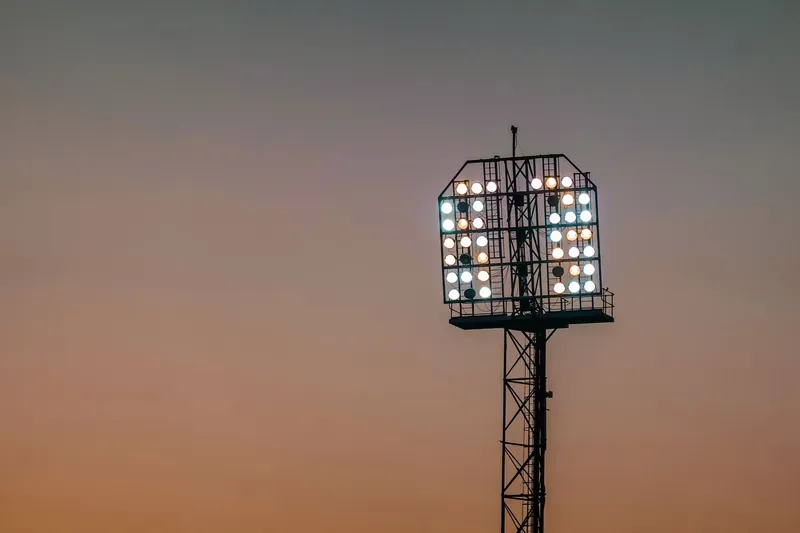 300–500 lux LED lighting8 × 200W asymmetric LED arrays with low boundary light spill.
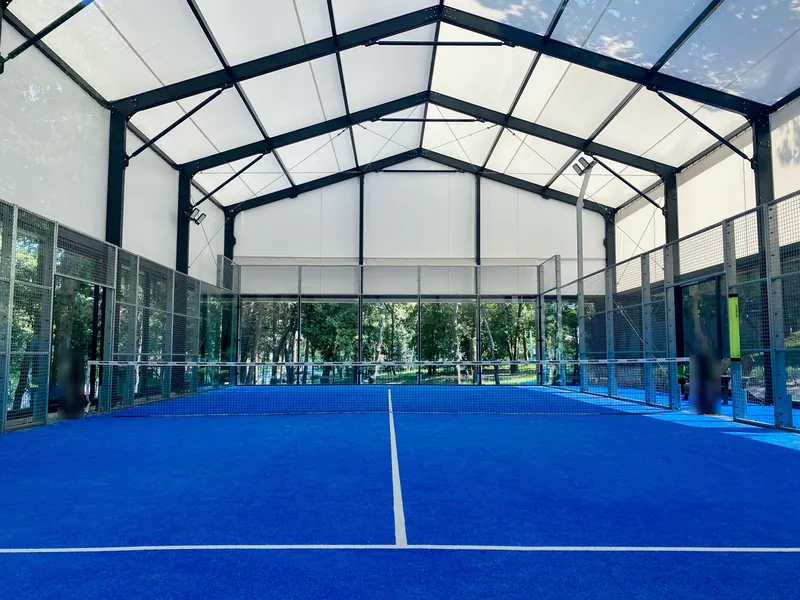 Covered canopy courtsArched and mono-pitch steel roofs with 7 m to 8 m clear eaves.Sports Capital grantsCSFF / SCEP eligibility, match funding and non-official guidance.
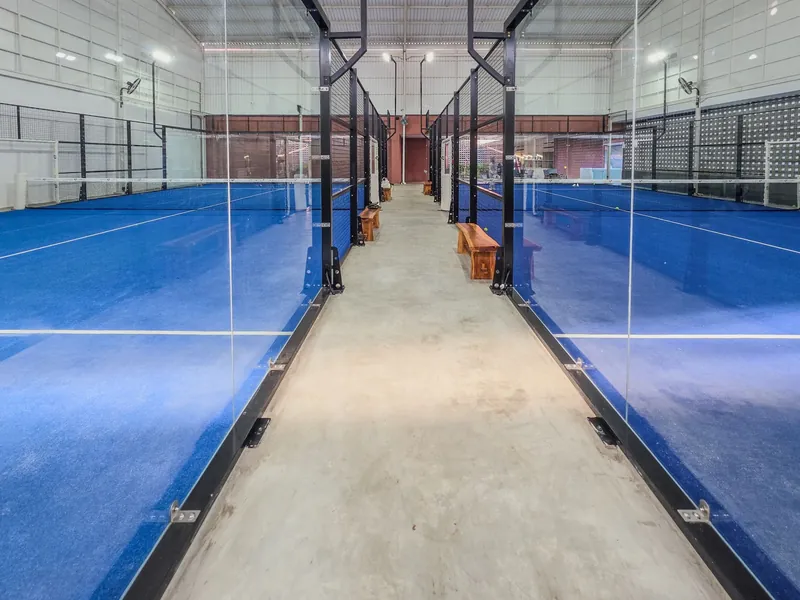 Padel courts DublinZone 3 wind spec, Dublin councils, warehouses and noise limits.
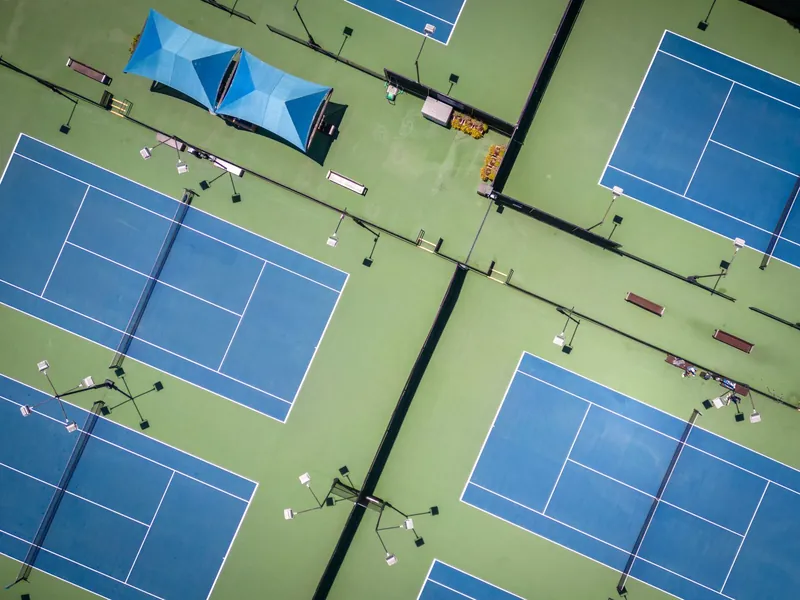 Tennis court conversionsFitting 2 to 3 padel courts onto a disused hard tennis bay.
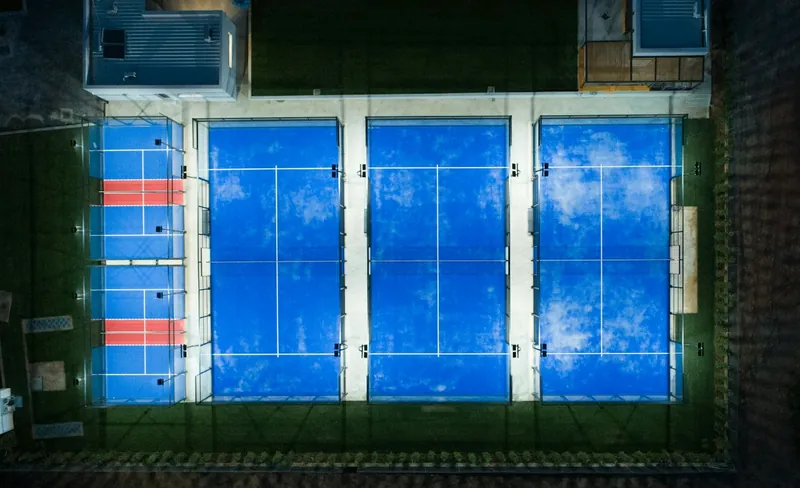 Multi-court club builds2 to 6+ court layouts for GAA, tennis and commercial venues.
Padel build questions answered
Can we replace a disused tennis court with padel courts without planning permission?
No in almost all cases. Even inside an existing fenced tennis club, adding 4 m glass walls, concrete ring beams and new floodlighting normally requires full council planning permission.
What does an acoustic Noise Impact Assessment (NIA) involve?
An acoustic engineer logs baseline background noise at nearby houses, models padel strike and voice sound propagation to the nearest bedrooms, and specifies barrier height, orientation or operating hours to stay within council limits.
How long does Irish planning permission take for padel courts?
Councils issue a first decision within 8 weeks of a valid application (plus 4 weeks appeal period), extending to 4 to 6 months if a Request for Further Information (RFI) is issued.
Does an indoor warehouse padel club need planning permission?
Yes. Converting a warehouse or light-industrial unit to commercial indoor recreation requires Change of Use planning permission plus Fire Safety and Disability Access Certificates.
All padel court pages and technical guides
Court types
Engineering, costs & planning
Price your padel court build before breaking ground
Choose the court model, court count and groundworks scope to view an Irish ex-VAT estimate. When you want a written tender, your outline goes to a single padel court builder covering your county.